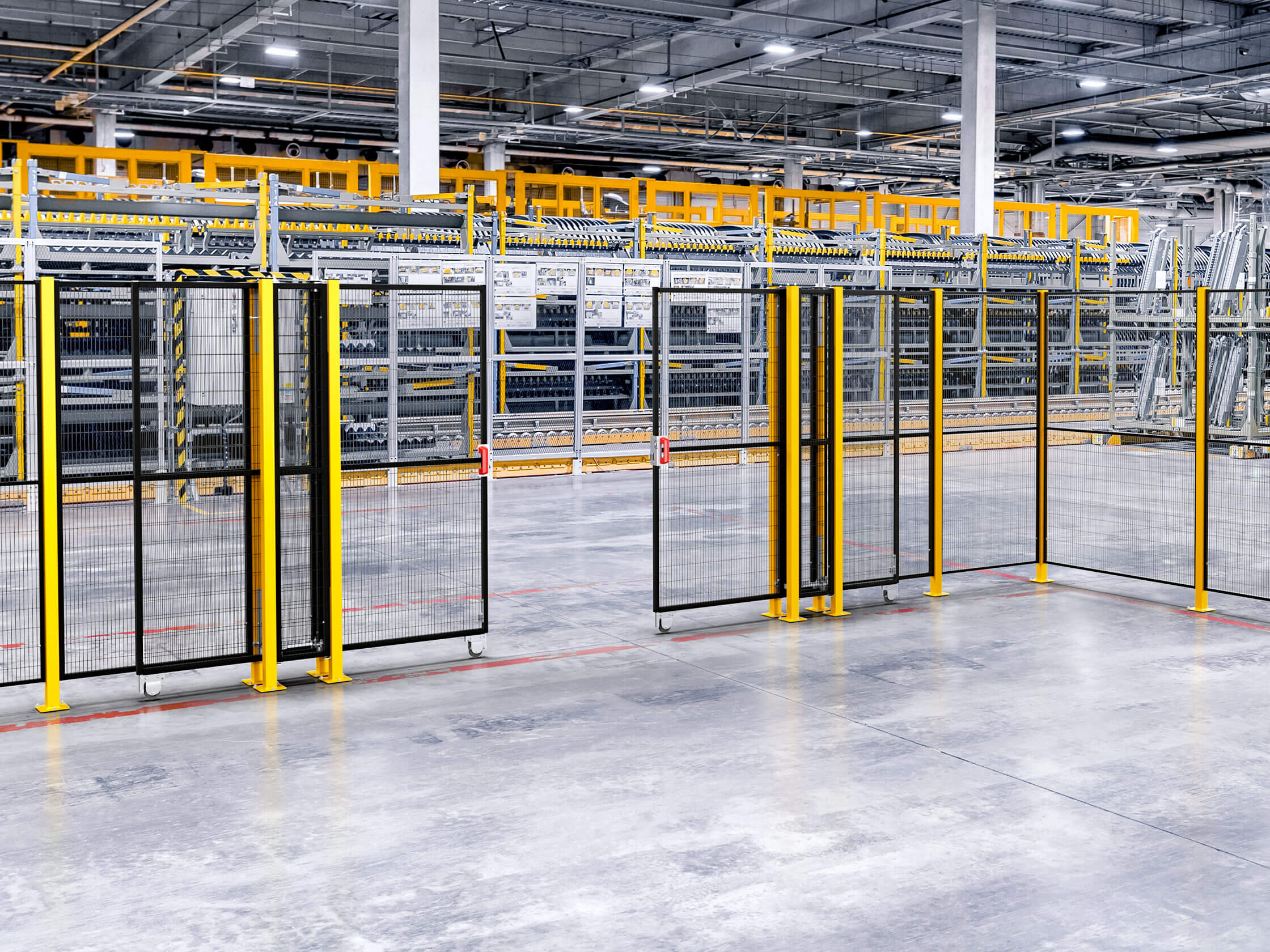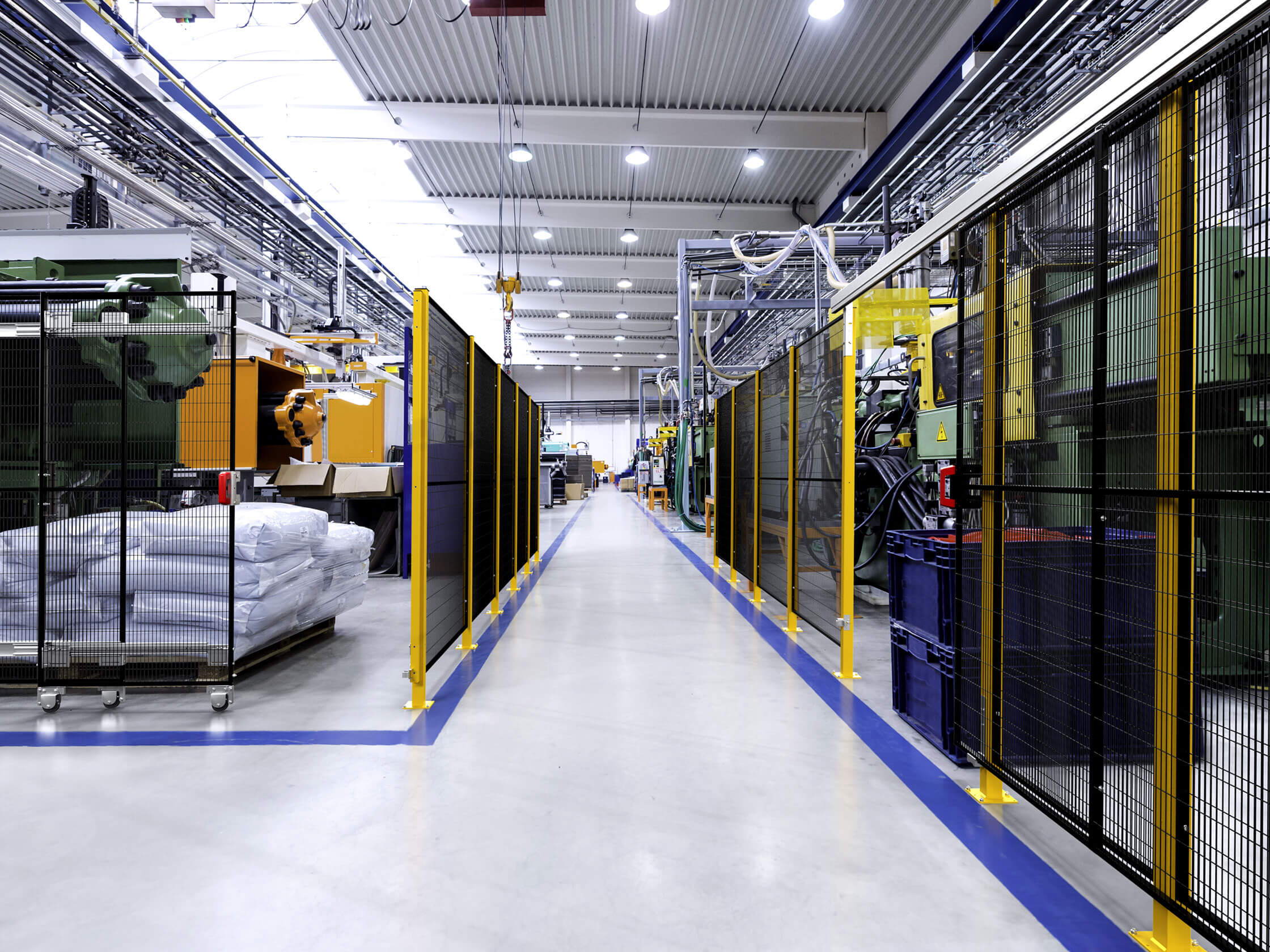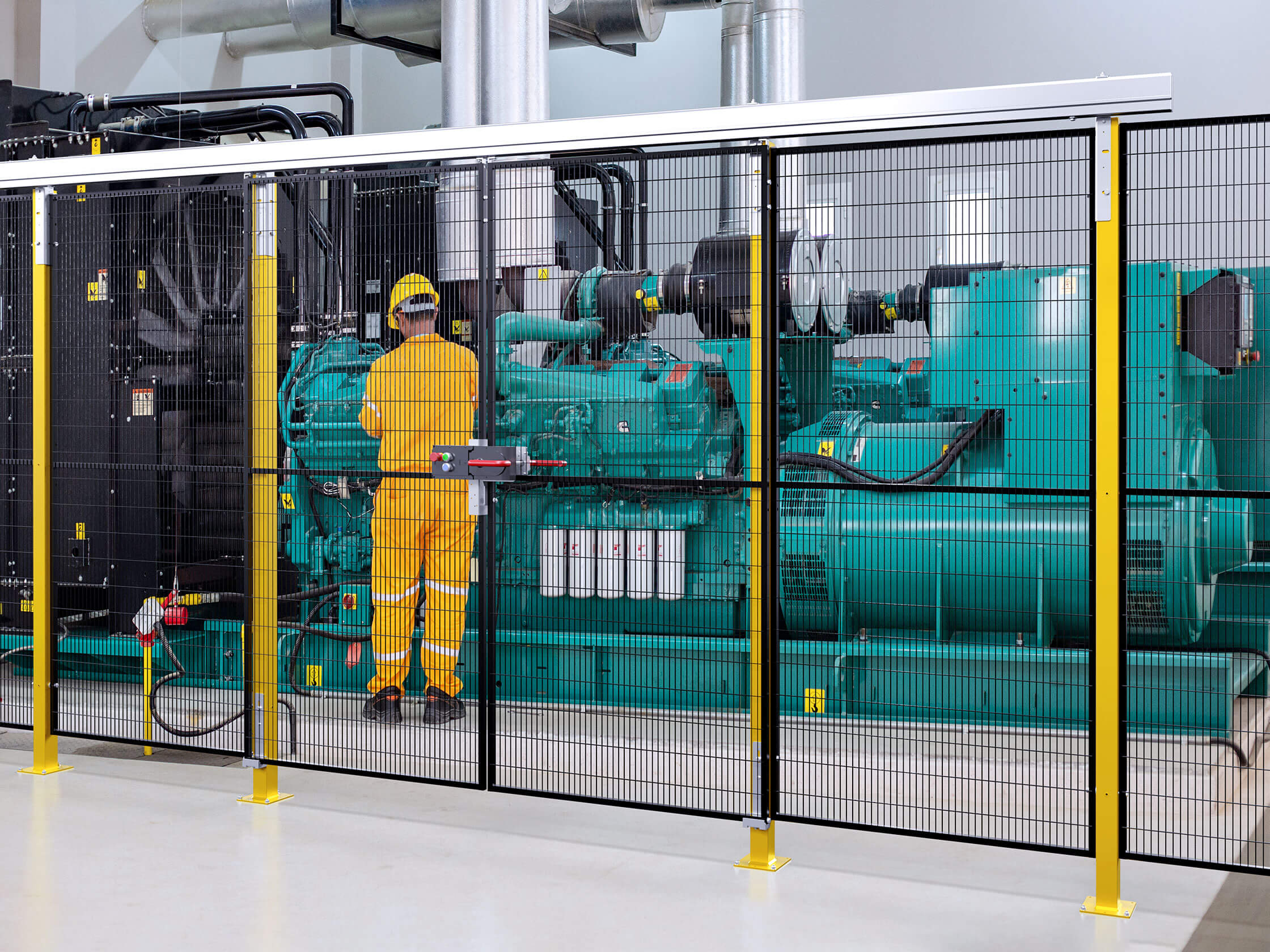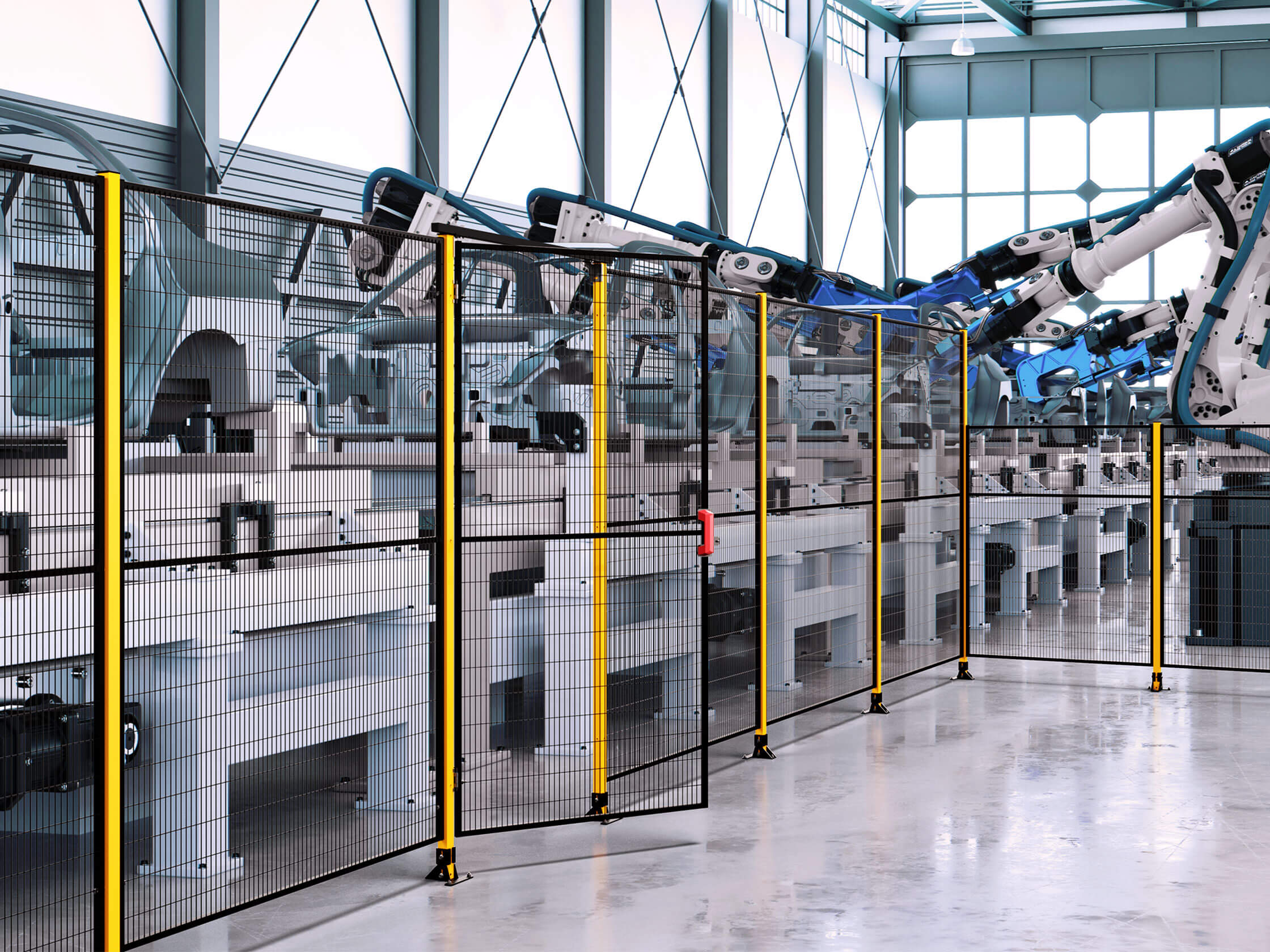
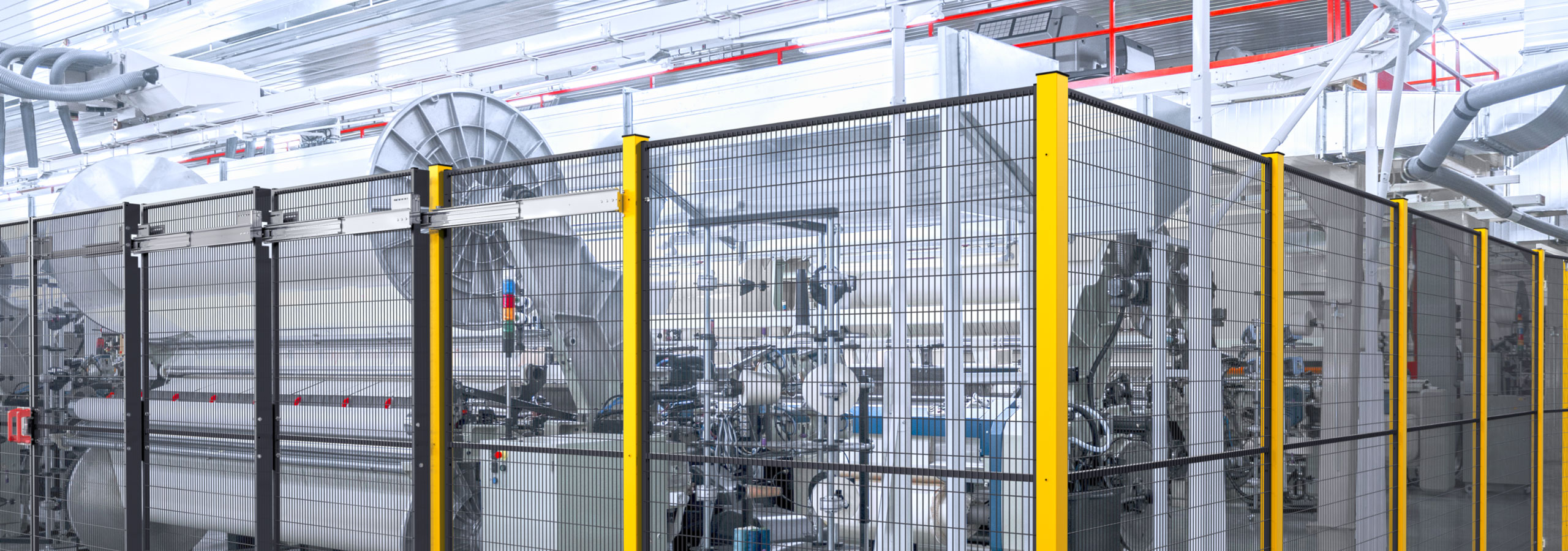
The Sturdy Machine Guard featuring Reinforced Posts.
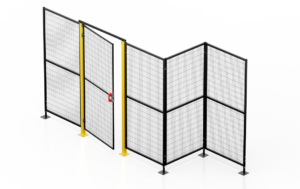
ImpactGuard is the OSHA-compliant Machine Guard designed for maximum robustness and durability. Featuring two post and frame options, ImpactGuard ensures maximum stability in all configurations, making it the perfect choice for heavy-duty applications, such as in the steel industry.
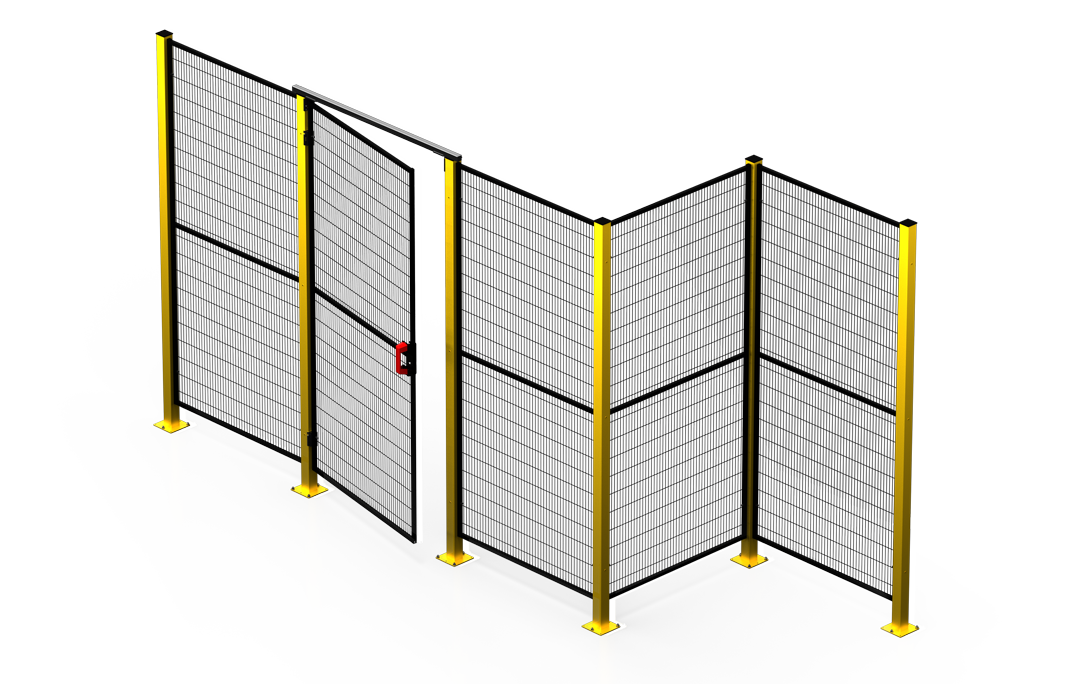
ImpactGuard - OSHA-compliant Machine Guard
Key System Features
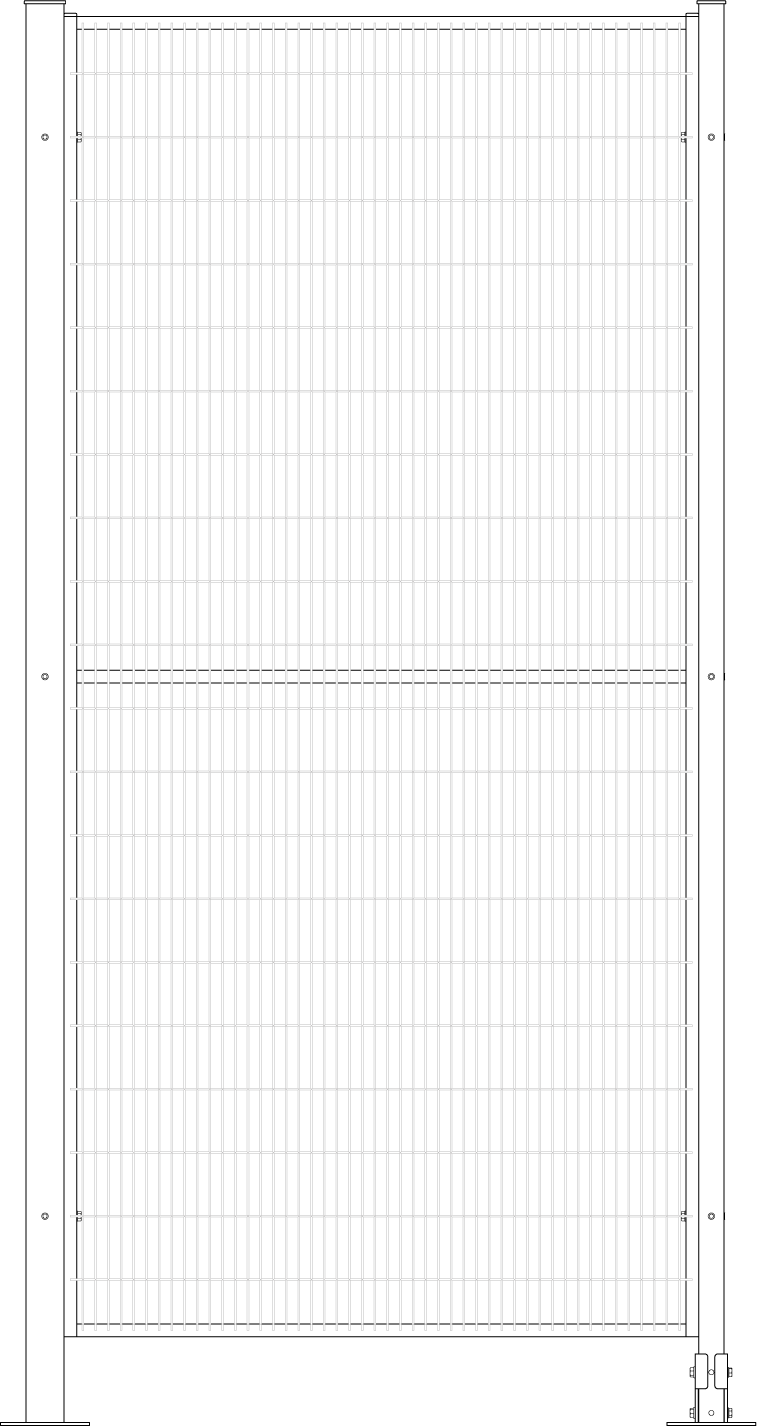
Panels
- MESH (mm)
- 20 x 100 x 3
- MESH SLOT (mm)
- 17 x 97
- WIDTHS (mm)
- 200300700800100012001500
7 STANDARD WIDTHS, INFINITE POSSIBILITIES

The combination of our 7 standard panels joined together allows to create all the intermediate widths in 100 mm increments.
- HEIGHTS (mm)
- 20802480
Posts
- BASEPLATES
- 60 mm post: 140 x 140 x 5, welded 40 mm post: to be assembled (adjustable)
- HEIGHTS (mm)
- 22402640
Colors
- RAL COLORS
- RAL 9005 RAL 1021 CustomGuard Colors
- COATING
- Powder (for indoor use only)
Our Modular Framed Panel
Safe, Practical and Resistant

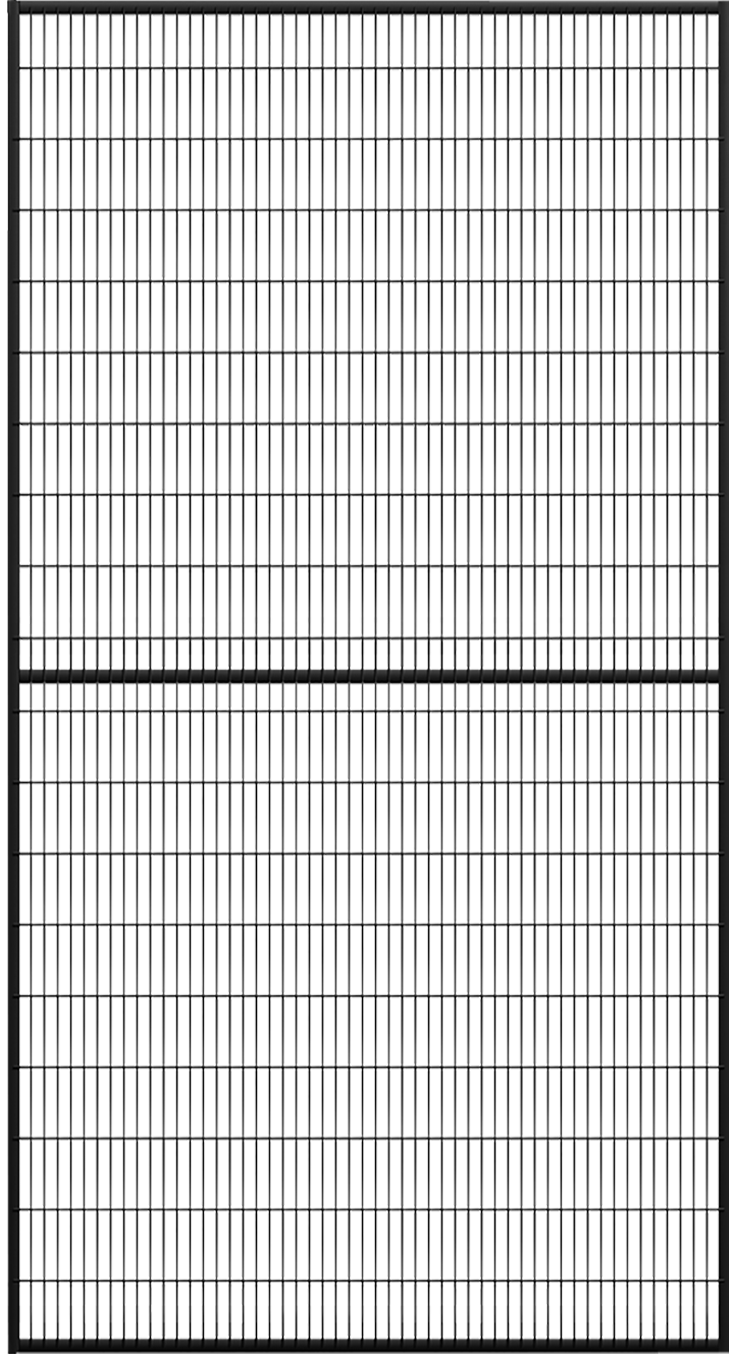


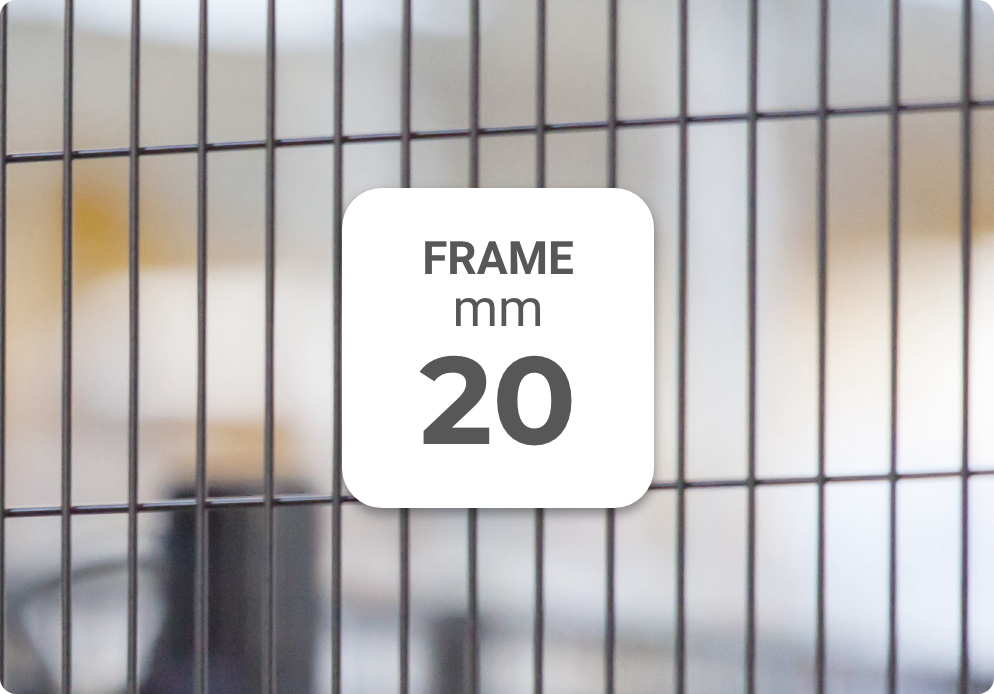


New “Mix & Match” Posts
The new Universal posts from Satech are designed for full compatibility with all Satech panels. Offered in section sizes of either 40 or 60 mm, these posts come equipped with innovative adjustable 3-anchoring points Baseplates, engineered to ensure enhanced stability and robust resistance against accidental impacts.


Two New Baseplates
- Stability and resistance
- Optimized ground anchoring
- Adjustable tilting and height

Impact-Resistant Assembly
Our latest ImpactGuard captive fastening system complies with the Machinery Directive (2006/42/EC) and offers a streamlined design with fewer components, significantly improving assembly efficiency. This System also ensures superior impact resistance, meeting the rigorous standards of the Impact Test as per EN ISO 14120.

 |  |  | ||
|---|---|---|---|---|
| Machine Guard - Standard heights (mm) | 2220, 2620 | 2220, 2620 | 2220 | |
| Frame section (mm) | 20 | 20 | 20 | |
| Post section (mm) | 40 / 60 | 40 / 60 | - | |
| Captive Assembly System | Quick Clamp | Screws | Upper Connections + Special Baseplates | |
| Price range | $$ / $$$ | $$ / $$$ | $ | |
| Speed of assembly | ||||
| Mesh (mm) | 20 x 100 x 3 | 20 x 100 x 3 | 20 x 100 x 3 | |
| Tested resistance to Impact (max) | 250 J | 2200 J | 390 J | |
| Min. Distance from hazard (mm) | 120 (EN ISO 13857) | 120 (EN ISO 13857) | 120 (EN ISO 13857) | |
| Non-mesh panel options(FullSteel, transparent sheet, mixed) | - |
OSHA Machine Guards for Industrial Robots: Frequently Asked Questions (FAQ)

What are machine guards for industrial robots?
Machine guards for industrial robots are physical protection systems that enclose machinery, robots or automated production cells, creating a continuous barrier between hazardous areas and operators.
The applicable construction standard is EN ISO 14120. ImpactGuard is Satech's solution for environments where guards must withstand high-energy impacts: tested to 2200 J (1623 ft-lb) with both 1.6 in (40 mm) and 2.4 in (60 mm) posts using a 0.8 in (20x20 mm) frame, and 2600 J (1917 ft-lb) with 2.4 in (60 mm) posts and a 1.2 in (30x30 mm) frame, per EN ISO 14120 Annex C.
Which environments are ImpactGuard OSHA machine guards designed for?
ImpactGuard is built for high-impact environments: foundries and stamping lines, robotic welding or heavy assembly cells, islands with high-power industrial robots, and any setting where guards are exposed to repeated shocks or significant dynamic forces.
The structure with captive-screw posts maintains its structural integrity even under intensive operating conditions.
What makes a fixed guard like ImpactGuard compliant with EN ISO 14120?
A fixed guard must not be able to remain in place once its fasteners are removed. Screws, bolts and nuts must stay attached to either the guard or the machine to prevent them from falling into moving parts.
ImpactGuard's captive-screw system is designed to meet this requirement under EN ISO 14120 clause 5.3.9, keeping all fixing components secured to the structure even during maintenance disassembly.
In the United States, OSHA 29 CFR 1910.212(a)(2) separately requires that guards be affixed to the machine where possible, and secured elsewhere when attachment to the machine is not possible.
What does perimeter guarding in robot cells mean?
Perimeter guarding in robot cells refers to the physical barriers that isolate the robot's working area, preventing unauthorized access during automatic cycles.
In the United States, the reference standard for industrial robot systems is ANSI/A3 R15.06-2025, the U.S. national adoption of ISO 10218-1:2025 and ISO 10218-2:2025. It updates and replaces ANSI/RIA R15.06-2012, which is being withdrawn, and covers safety requirements for robot applications and robot cells, including safeguarding.
ImpactGuard is designed for high-impact environments, including robot cells. Selecting the right solution for a specific application still requires a Risk Assessment. See our reference standards page for more detail.
Can ImpactGuard machine guards withstand the impact of an industrial robot?
ImpactGuard is tested to 2200 J (1623 ft-lb) — 1.6 in (40 mm) and 2.4 in (60 mm) posts, both with a 0.8 in (20x20 mm) frame, per EN ISO 14120 Annex C.
Two impact forces are relevant to system selection: from outside (reference minimum 115 J / 85 ft-lb, equivalent to a person of roughly 200 lb / 90 kg falling against the guard) and from inside (material ejected by the process).
Determining the correct value for your specific application requires a Risk Assessment under EN ISO 12100, or the equivalent risk assessment process in ANSI B11.0.
What is the minimum installation distance for ImpactGuard machine guards?
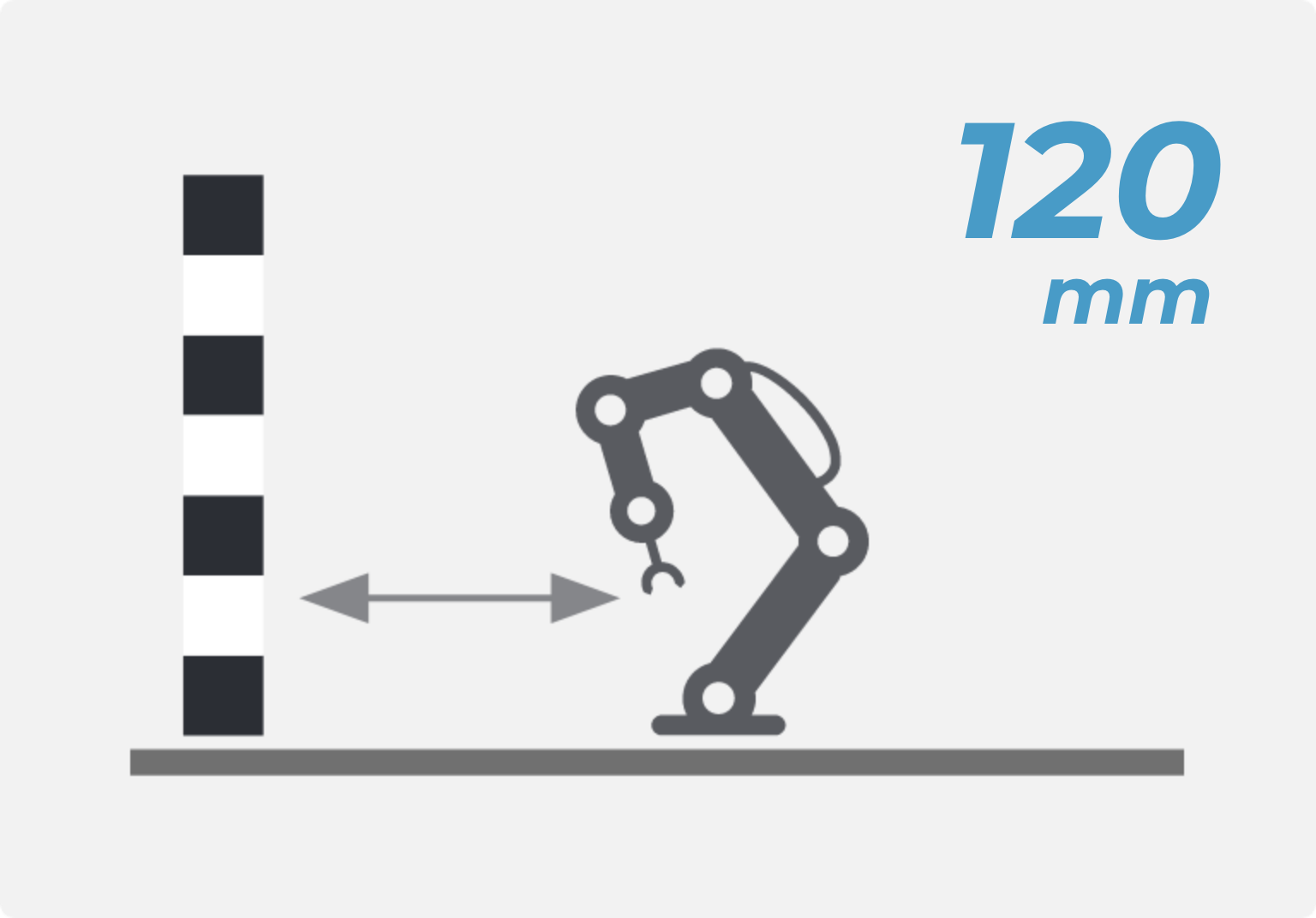
Thanks to its framed mesh panel design, ImpactGuard can be installed at a minimum distance of 4.7 in (120 mm) from the hazard.
This distance is made possible by the 0.67 x 3.82 in (17 x 97 mm) mesh opening, sized to prevent reaching through the panel to dangerous areas per EN ISO 13857, clause 4.2.4.1. In North America, the equivalent guard-opening and reach tables are those of ANSI B11.19.
However, mesh aperture alone is not sufficient to define correct guard positioning: the height of the hazard point must also be taken into account. A Risk Assessment is essential to determine both guard height and safety distance accurately.
How should ImpactGuard machine guards be maintained?
Satech recommends periodic checks every three months, with particular attention for installations subject to frequent vibrations or impacts.
Checks include tightening the captive-screw fixings and inspecting mesh panels for any damage after impacts. Damaged components must be replaced immediately to maintain the rated 2200 J (1623 ft-lb) impact resistance.
For installations with integrated Safety Switches or interlocks, the maintenance program must include functional testing of the devices per EN ISO 14119 and the manufacturer's instructions.
A guard that has been damaged, loosened or left unsecured no longer provides the protection required by OSHA 29 CFR 1910.212, so keeping the perimeter in effective condition is part of maintaining compliance.
How do I install ImpactGuard on grating floors or non-drillable metal surfaces?
ImpactGuard can be installed on special floor types using a floor counter-plate, available in two versions: galvanized for gratings up to 1.2 in (30 mm) thick, and weld-on steel for metal surfaces where drilling is not possible or advisable.
Both versions are compatible with the 1.6 in (40 mm) and 2.4 in (60 mm) posts. Further details are available on our accessories and brackets page.
ImpactGuard - OSHA Machine Guard
Resources
ImpactGuard - Assembly Instructions
DownloadImpactGuard’s 3D Models Are Available for Download on TraceParts!
COMPLETE LIBRARYProducts and Complements
Enhance ImpactGuard's Functionality by Choosing Among Our Premium Doors, Panels, Locks, and Accessories.

Standard Doors
A versatile range of doors enabling access to machinery for personnel, pallet trucks, forklifts and overhead cranes.
Browse our doors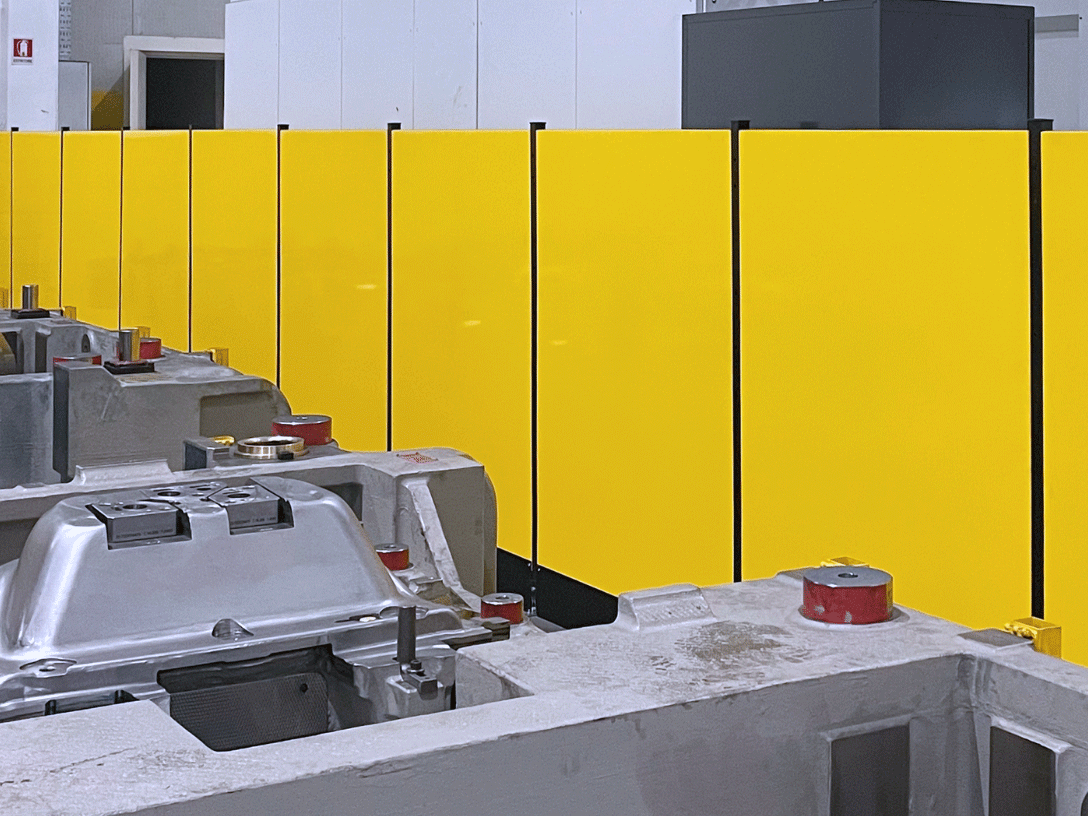
Modular Panels
A variety of panel options beyond traditional mesh, offering diverse material choices for specific applications.
Browse our panels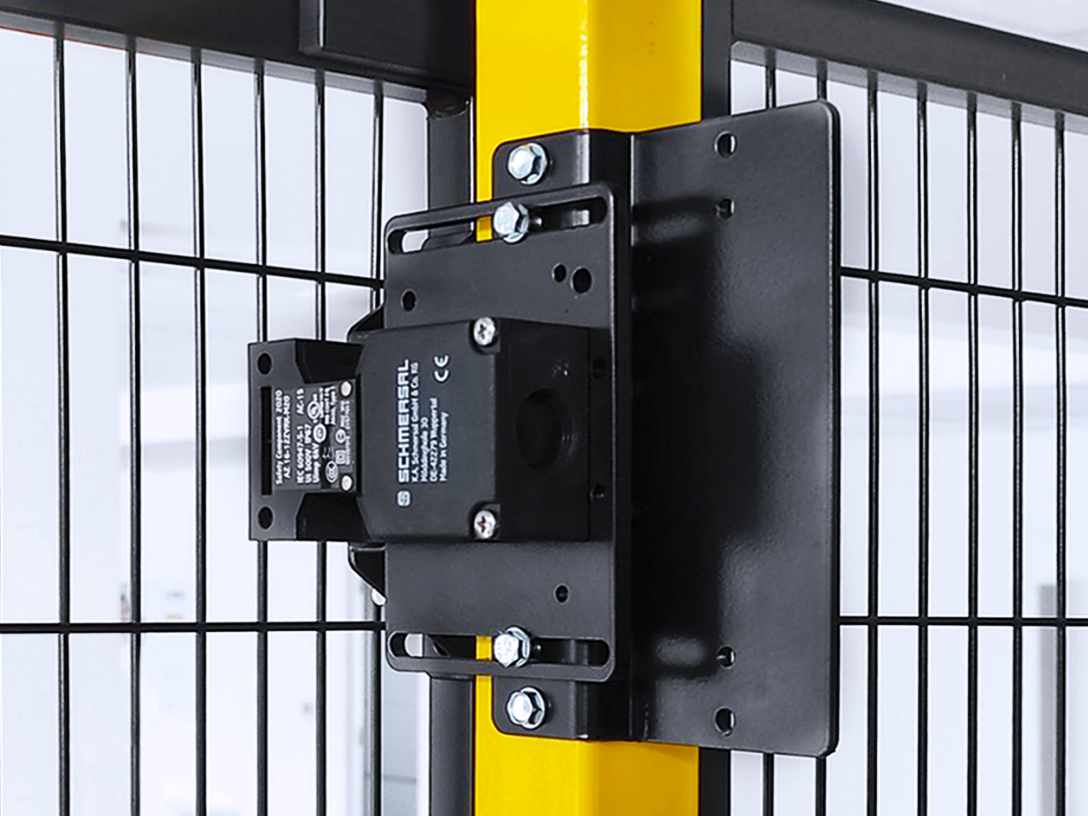
Locking Systems
An array of locking options tailored to meet the diverse Performance Levels necessary for optimal security in industrial environments.
Browse our locking systems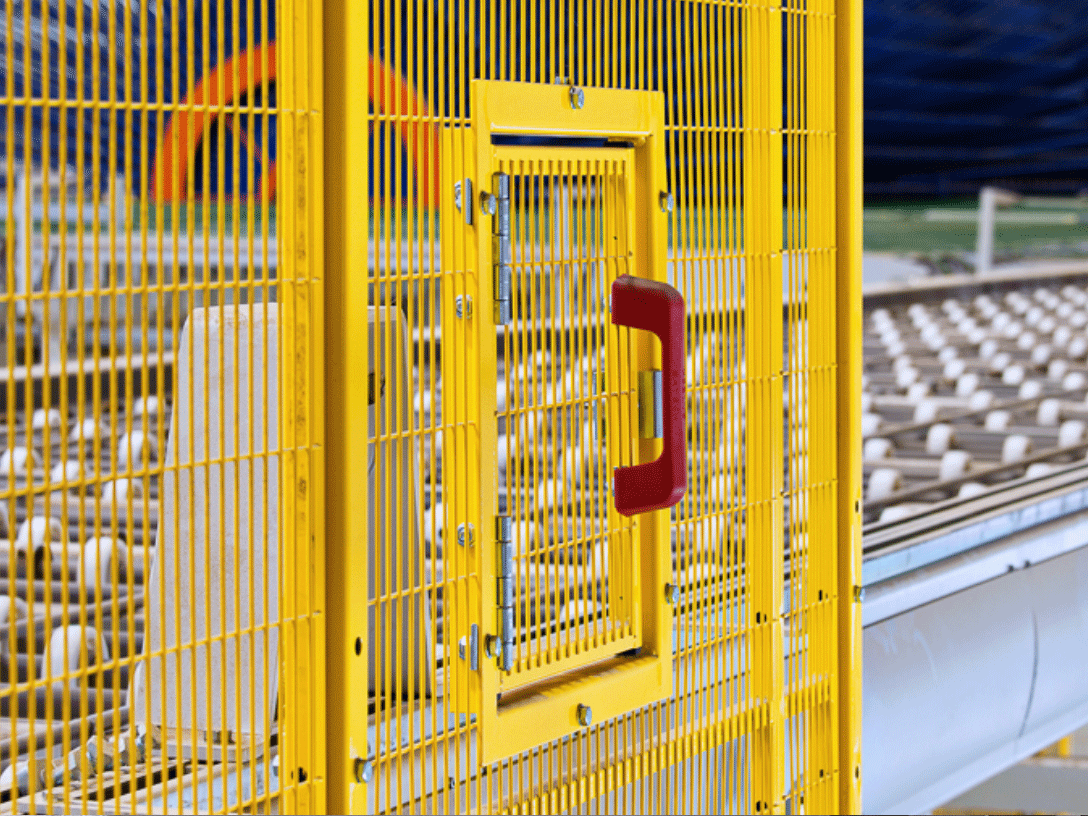
Accessories and Brackets
An extensive selection of mounting Accessories and Brackets to complete the setup of your Machine Guard.
Browse our accessories